
ADS1115 16 Bit I2C Module
5.0Editor score
16 Bit resolution ADC
4 Channel analog inputs
I2C interface support
This guide compares the top Arduino ADC Board options for precision analog sensing, detailing resolution, channels, and interface types for your next project.
Finding the right Arduino ADC Board is crucial for projects requiring precise analog measurements. These boards convert continuous signals into digital data your microcontroller can process. A good module offers high resolution, multiple channels, and stable performance under various conditions.
We evaluated ten leading ADC modules based on resolution, input channels, communication interfaces, and build quality. Our analysis considers compatibility with popular microcontrollers like Arduino and Raspberry Pi. Each selection balances performance with ease of use for makers and engineers.
Each product pick highlights key specifications, standout features, and ideal use cases for your specific application. Note that availability and pricing may fluctuate over time due to market demand. Always check the latest product pages for current stock and shipping options before purchasing.
5.0Editor score

4.6Editor score

4.4Editor score
This table provides a side by side comparison of all ten selected ADC modules. It highlights key specifications to help you quickly identify the right board for your needs.


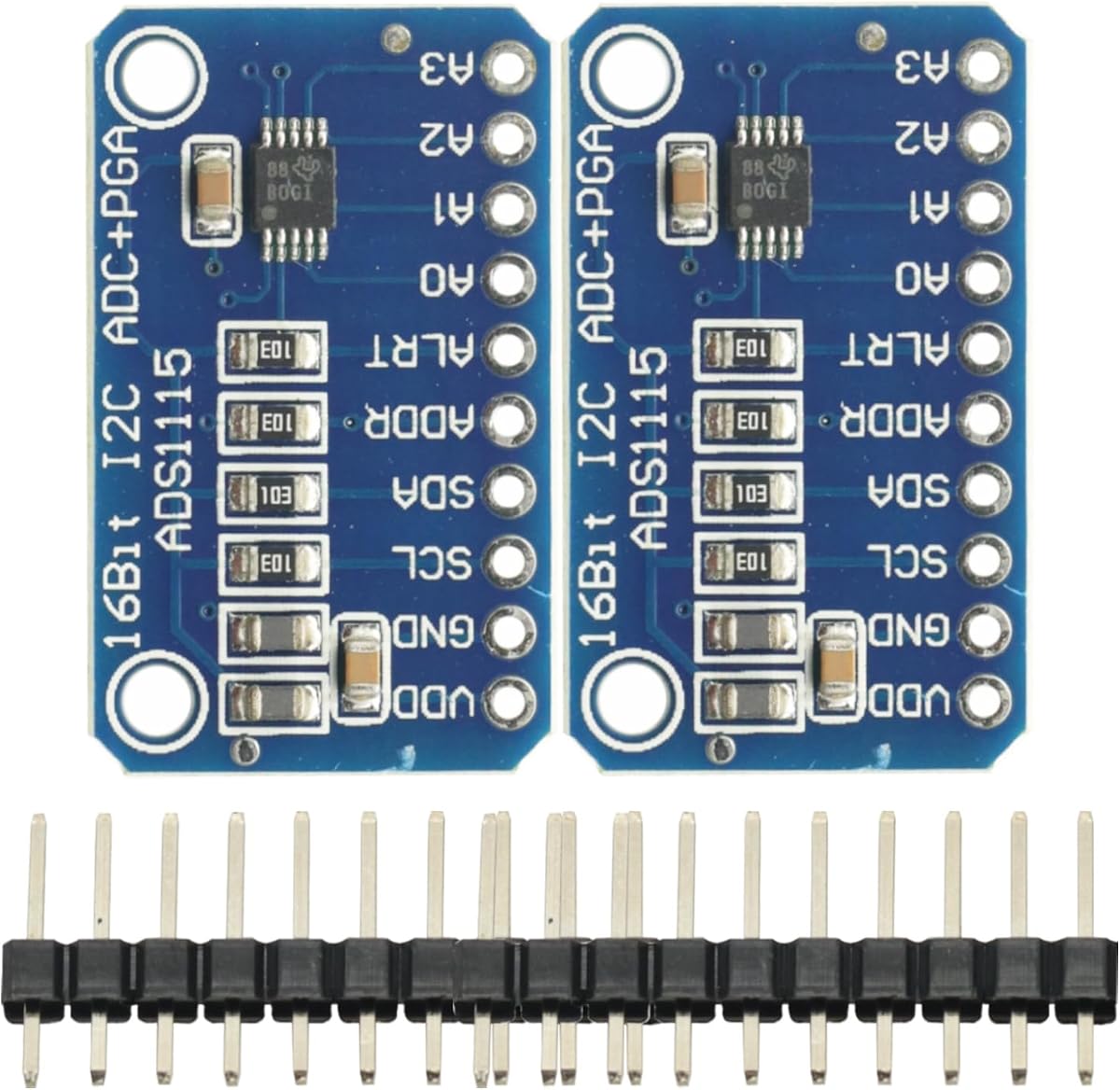


This three pack bundle offers exceptional value for makers needing multiple ADC channels across different projects. Each board delivers high precision 16 bit conversions via a simple I2C interface. It is highly rated for reliability and consistent performance in diverse sensing applications.
We may earn a commission when you buy through this link, at no additional cost to you.
The integrated programmable gain amplifier allows you to measure small voltage changes accurately. This feature is vital for sensors like thermocouples or strain gauges. You can choose input ranges from ±0.256V to ±6.144V to match your specific signal levels perfectly.
While the boards are compact, they may require careful wiring for beginners. Additionally, you will need to install specific libraries to interface with the microcontroller. These minor hurdles are outweighed by the flexibility and accuracy this module provides.
Ideal for students and hobbyists building multiple sensor nodes or data loggers. The ability to daisy chain up to four modules means you can scale your inputs easily. This makes it a versatile choice for complex monitoring systems.
You can connect up to four modules on the same I2C bus for 16 channels. This allows for comprehensive environmental monitoring in a single setup.
The onboard PGA lets you adjust sensitivity without extra hardware. This ensures optimal readings for both low and high voltage signals.
We may earn a commission when you buy through this link, at no additional cost to you.
This module stands out with its 24 bit resolution, offering unmatched precision for scientific instruments. It uses an SPI interface which is faster than I2C for data transfer. The onboard reference voltage ensures stable readings over time and temperature changes.
We may earn a commission when you buy through this link, at no additional cost to you.
You can configure it for either eight single ended or four differential inputs. This flexibility supports a wide variety of sensor types and signal conditions. The nonlinearity is exceptionally low, making it suitable for accurate calibration tasks.
The requirement for SPI communication might limit pin availability on some microcontrollers. Power usage is also higher than simpler I2C modules. However, for applications where accuracy is paramount, these trade offs are justified.
Best suited for lab equipment, high fidelity audio projects, or industrial monitoring. If you need to capture subtle changes in signal without noise, this board delivers. It is a professional grade tool for serious makers.
The low nonlinearity specification ensures that your measurements remain true across the entire range. This is critical for scientific experiments requiring precise data.
Differential inputs help reject common mode noise effectively. This makes the module robust in electrically noisy environments like factories.
We may earn a commission when you buy through this link, at no additional cost to you.
This two pack provides a reliable entry point for analog to digital conversion projects. Users report a perfect satisfaction score, highlighting consistent quality and functionality. The I2C interface makes it very easy to connect to most microcontrollers.
We may earn a commission when you buy through this link, at no additional cost to you.
With four input channels, you can monitor multiple sensors without needing extra boards. The programmable data rate allows you to balance speed and power usage. This is useful for battery powered applications where efficiency is key.
The maximum sample rate is lower than high end modules, which may not suit fast signals. The packaging is minimal, so you may need to solder headers yourself. These are minor issues for such a capable and affordable module.
Great for educational projects, home automation, and general hobbyist use. It simplifies analog sensing without complex coding or wiring. If you need a solid ADC without breaking the bank, this is an excellent choice.
You can reduce the sample rate to save power during idle times. This feature extends battery life in remote sensor deployments.
The range selection helps match the ADC to your sensor output. This prevents signal clipping and ensures accurate digitization.
We may earn a commission when you buy through this link, at no additional cost to you.
This bundle offers three identical modules for projects requiring redundancy or multiple stations. The design is straightforward, focusing on essential features without unnecessary complexity. It is particularly noted for working well with Raspberry Pi systems.
We may earn a commission when you buy through this link, at no additional cost to you.
The comparator mode helps maintain accuracy when thresholds are critical. Auto shut down in single shot mode saves power when full sampling is not needed. This combination makes it efficient for monitoring tasks that do not run continuously.
The user base is smaller compared to other popular models, which might affect community support. The small form factor requires precision when soldering or using breadboards. However, it remains a robust tool for general purpose ADC needs.
Recommended for classrooms or workshops where multiple students need modules simultaneously. It allows for parallel project development without running out of parts. This supports collaborative learning environments effectively.
Comparator mode lets you set alerts for specific voltage levels. This is useful for safety or alarm systems.
Designed to bridge the gap where Pi lacks analog GPIO pins. This simplifies wiring for Linux based single board computers.
We may earn a commission when you buy through this link, at no additional cost to you.
Getting four boards in one package is cost effective for large scale installations. The module supports simultaneous sampling of differential signals, which is crucial for balanced audio or bridge sensors. This ensures no timing skew between channels.
We may earn a commission when you buy through this link, at no additional cost to you.
The onboard oscillator provides a stable clock source without external components. You can operate in single shot mode to minimize power draw significantly. These features make it suitable for battery operated sensing nodes.
Some users may find the documentation sparse, requiring more initial setup time. The average rating suggests some variance in quality control across batches. Despite this, it offers significant value for bulk procurement needs.
Ideal for deployment in agricultural monitoring or building automation. You can distribute these across different zones without high costs. The bulk option ensures you have spares ready for maintenance.
Differential inputs reject noise common to both lines. This improves signal quality in electrically noisy industrial settings.
An internal oscillator ensures consistent sampling rates. This reduces jitter in time dependent measurement systems.
We may earn a commission when you buy through this link, at no additional cost to you.
This pair delivers consistent performance, reflected in the perfect user rating score. It offers seven distinct input ranges, allowing flexibility for various signal amplitudes. The design is clean, making soldering and mounting straightforward.
We may earn a commission when you buy through this link, at no additional cost to you.
The ability to handle both single ended and differential inputs adds to its versatility. You can switch between modes easily depending on the sensor connected. This reduces the need for multiple different types of conversion hardware.
Some users may find the voltage range selection process confusing initially. The compact size can make debugging harder for those new to soldering. However, the performance is reliable for most standard applications.
Best for robotics or wearable electronics where space is limited. It provides high precision without adding significant bulk to your device. This makes it a strong candidate for portable projects.
Seven input ranges let you fine tune the ADC for your signal. This maximizes resolution for both weak and strong inputs.
The small size fits easily into tight enclosures. This is ideal for wearables or mobile devices.
We may earn a commission when you buy through this link, at no additional cost to you.
This premium pack features ENIG plating on headers for better oxidation resistance. It is designed for long term reliability in harsh environments or frequent re soldering. The brand focuses on open source compatibility with various ecosystems.
We may earn a commission when you buy through this link, at no additional cost to you.
It supports a wide range of microcontrollers including ESP32 and Raspberry Pi. Library support for C++ and MicroPython simplifies the software integration process. This reduces development time significantly for experienced users.
The cost is higher than generic alternatives, which may not fit tight budgets. The branding might be less known, but the quality standards are clear. This is a trade-off for better durability and finish.
Recommended for professional prototypes or educational institutions. The build quality ensures that boards survive repeated use in labs. This is a solid investment for long term reliability.
Gold plating prevents corrosion on exposed pins. This maintains good electrical contact over long periods.
Works with many popular microcontroller libraries. This ensures you can integrate it into almost any project.
We may earn a commission when you buy through this link, at no additional cost to you.
This module excels in synchronous sampling, capturing all channels at the same instant. This is essential for analyzing phase relationships between signals. The high sampling frequency allows tracking of rapid changes effectively.
We may earn a commission when you buy through this link, at no additional cost to you.
It features eight independent channels which can be sampled simultaneously. The parallel output interface is fast but requires more microcontroller pins. This makes it complex to integrate compared to simpler serial interfaces.
Users report challenges with wiring and configuration complexity. The lower rating reflects these integration hurdles for casual hobbyists. However, the performance is solid for specific high speed needs.
Best for oscilloscopes, vibration analysis, or audio processing. If timing alignment between channels is critical, this module is unmatched. It serves specialized engineering tasks well.
Simultaneous sampling ensures no phase shift between channels. This is vital for multi phase power analysis.
The high sampling rate captures fast transients accurately. This prevents aliasing in dynamic signal environments.
We may earn a commission when you buy through this link, at no additional cost to you.
This four pack offers a great balance between quantity and quality for general use. The modules deliver stable readings that are crucial for long term logging. They integrate easily with a vast array of microcontrollers out of the box.
We may earn a commission when you buy through this link, at no additional cost to you.
Each unit comes with programmable gain amplifiers for improved sensitivity. This means you can measure very small signals without extra hardware. The simplicity of the I2C interface makes wiring tasks quick and clean.
The packaging is generic which might be less appealing for professional presentation. Some boards may require headers to be soldered before first use. These are minor considerations for the value offered in bulk.
Excellent for IoT sensor networks or home monitoring setups. You can deploy multiple nodes across your property easily. The quantity ensures you can replace any faulty units quickly.
Designed to integrate seamlessly with wireless platforms. This supports building connected sensor networks effortlessly.
Stable readings ensure your data logs remain accurate over time. This is essential for environmental monitoring projects.
We may earn a commission when you buy through this link, at no additional cost to you.
This single module is a standard reference for many basic Arduino projects. It offers reliable performance with a broad range of supported libraries. The design focuses on simplicity to minimize integration errors.
We may earn a commission when you buy through this link, at no additional cost to you.
The wide supply voltage range allows direct connection to various logic levels. Comparator mode provides additional functionality for threshold checking without software. This versatility makes it a safe choice for beginners.
Some users may find the resolution adequate but not exceptional for very sensitive work. The size requires careful handling during soldering processes. However, it remains a robust solution for typical needs.
Ideal for general hobbyist projects or prototyping phases. It covers most common analog input requirements without complexity. This is a solid pick for first time users of ADC boards.
Simpler design reduces the learning curve for users. This encourages experimentation without deep technical hurdles.
Built-in comparator helps detect specific voltage triggers. This simplifies alarm or safety logic implementation.
We may earn a commission when you buy through this link, at no additional cost to you.
Selecting the right ADC board depends on your specific measurement needs and system constraints. Here are the key factors to consider before purchasing.
Resolution determines how small a change in voltage the board can detect. Higher bit counts like 24 bits provide finer detail than 12 or 16 bits. Choose higher resolution for sensitive sensors or precise scientific instruments.
Look for high resolution bits to capture subtle signal variations accurately.
Channels define how many inputs you can connect simultaneously. Some boards offer 4 channels while others provide 8 or more. For multi sensor setups, more channels reduce the need for multiple boards.
Select a board with enough inputs for all your sensors.
Interfaces like I2C, SPI, or UART determine how the board talks to the microcontroller. I2C uses fewer pins but is slower, while SPI is faster but uses more pins. Match the interface to your board's available ports.
Ensure your microcontroller supports the chosen communication protocol.
Input range refers to the maximum voltage the board can accept safely. Some boards accept 0 to 5V, others ±10V. Matching this to your sensor's output prevents damage and ensures accurate readings.
Check sensor output limits against board input capabilities before connecting.
A built-in amplifier allows you to scale small signals before conversion. This improves effective resolution for low voltage sensors like strain gauges. Boards with PGA are more versatile than fixed gain options.
Prioritize boards with programmable gain for low voltage measurements.
Some boards require specific voltage levels like 3.3V or 5V. Others work across a wide range. Check compatibility with your power source to avoid instability or damage.
Verify that your power supply meets the board's voltage needs.
Sampling rate determines how many readings per second the board can take. Faster rates are needed for audio or vibration monitoring. Slower rates are sufficient for temperature or humidity sensors.
Ensure the sampling speed matches the dynamics of your signal.
Quality of soldering and materials affects reliability and durability. Some boards come pre-soldered while others need headers. Check reviews for consistency in manufacturing quality.
Look for consistent quality and robust construction in user feedback.
Connect the board securely to your microcontroller using the recommended interface wires. Ensure power lines are connected correctly to prevent short circuits.
Install the appropriate library for your specific ADC chip to handle data conversion. Test with a known voltage source to verify accuracy before deploying.
Protect the board from moisture and dust to ensure long term stability. Keep connections tight and avoid physical stress on pins during use.
I2C boards use fewer wires which saves pins but are generally slower. SPI boards use more wires but offer faster data transfer rates. Choose based on your available pins and speed requirements.
Yes, most ADC boards are compatible with Raspberry Pi via I2C or SPI. You may need to enable these interfaces in the OS settings first.
Use a board with a programmable gain amplifier to amplify small signals. This allows you to resolve smaller changes in voltage accurately.
16 bits is usually sufficient for most temperature and light sensors. Higher resolution is reserved for very precise scientific measurements.
Yes, you can connect multiple I2C modules by using different addresses. This allows you to expand your total channel count significantly.
Noise can come from electrical interference or unstable power. Use decoupling capacitors and shielded cables to reduce interference.
We highlighted the top three picks balancing cost, performance, and build quality. These options cover most needs from budget bundles to professional grade modules.
Prioritize resolution and input channels based on your specific sensor requirements. Match the interface to your microcontroller to simplify wiring and coding.
Prices and availability can change so always verify details on the product page before buying.