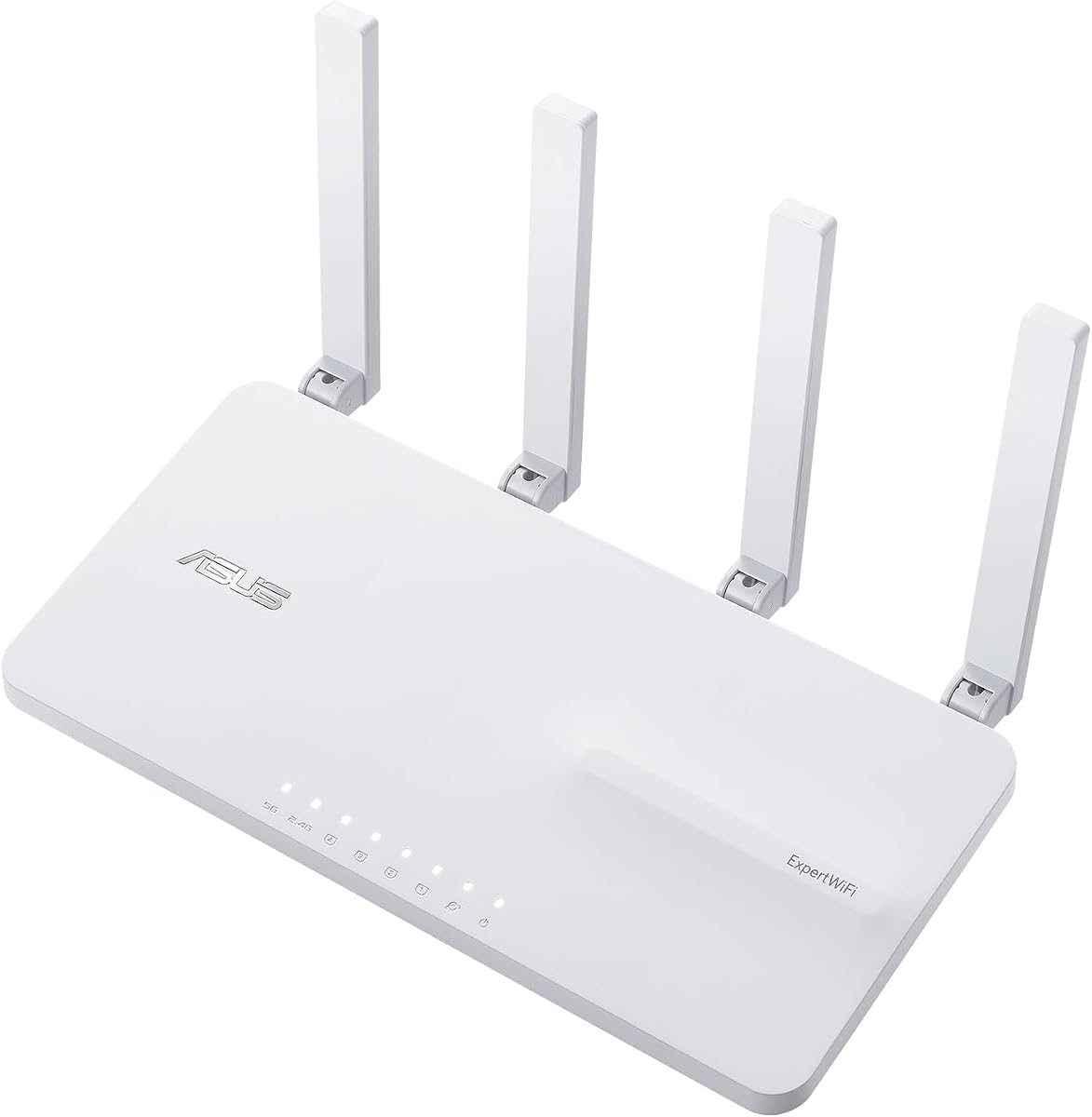
ASUS ExpertWiFi EBR63
4.2Editor score
Custom guest portal setup
Backup WAN connectivity
Free commercial security
This guide compares the top 10 commercial wireless routers for businesses in October 2026, evaluating performance, security, and manageability for diverse
Choosing the right commercial wireless router is critical for business operations. It ensures reliable connectivity for employees and customers while maintaining robust security standards across your network infrastructure effectively.
We evaluated ten leading models based on throughput, security features, and manageability. Our analysis focuses on real-world performance in office, retail, and hospitality settings to help you make an informed decision.
Each pick highlights key strengths and ideal use cases for your business. Prices may change frequently, so verify current offers before purchasing to ensure you get the best value for your investment today.
4.2Editor score
4.1Editor score

4.6Editor score
The following table provides a side-by-side comparison of all ten models. Use this to quickly assess key specifications and features before diving into detailed reviews and buying advice.




The ASUS ExpertWiFi EBR63 stands out as a powerful business router with a 4.2 rating. It combines robust security with user-friendly management features ideal for small to medium enterprises needing reliable connectivity.
We may earn a commission when you buy through this link, at no additional cost to you.
Its standout feature is the free commercial-grade security suite powered by AiProtection Pro, ensuring your network remains safe without extra subscription costs. The ability to customize guest portals allows businesses to align network access with their brand identity seamlessly.
While it offers extensive VLAN and SSID options, users should note the lack of advanced SFP port support found in higher-end models. This trade-off is acceptable given the balance of features and cost for typical business deployments.
This router is recommended for businesses seeking an all-in-one solution with strong security and manageable guest access. It provides the stability and control needed for professional environments without requiring extensive IT staff.
ASUS provides free AiProtection Pro subscriptions, offering advanced threat protection and secure browsing features that are typically paid add-ons in other commercial routers.
Businesses can tailor guest Wi-Fi portals with custom branding and portal types, enhancing customer experience while maintaining network segregation and security.
We may earn a commission when you buy through this link, at no additional cost to you.
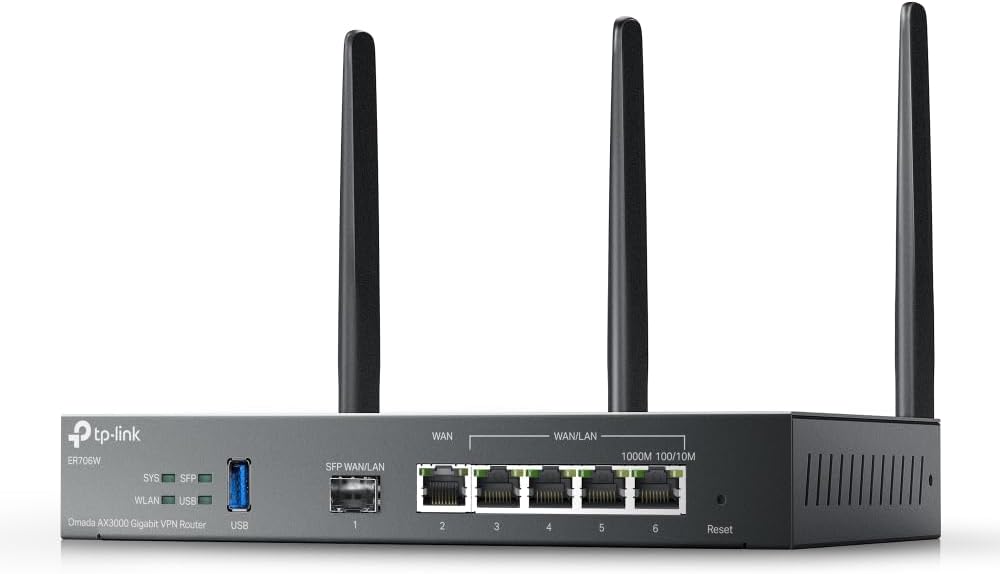
The Omada ER706W is a cost-effective option for businesses needing advanced routing features without breaking the bank. It scores a solid 4.1 and delivers reliable performance for environments requiring multi-WAN and VPN capabilities.
We may earn a commission when you buy through this link, at no additional cost to you.
Key strengths include the inclusion of a Gigabit SFP slot and robust load balancing across five WAN ports, which is rare at this price point. The router supports multiple VPN protocols ensuring secure remote access for distributed teams.
Users should be aware that maximizing its potential often requires an Omada controller or hardware, which adds to the total cost. Additionally, mesh expansion requires separate access points rather than integrated mesh routers.
This model is ideal for budget-conscious businesses that prioritize connectivity redundancy and secure remote access. It provides enterprise-grade routing features at a competitive price for growing networks.
With up to five WAN ports and load balancing, this router maximizes internet utilization and ensures network stability even if one connection fails.
Support for SSL, IPSec, WireGuard, and OpenVPN allows businesses to choose the most suitable secure tunneling protocol for their specific remote worker needs.
We may earn a commission when you buy through this link, at no additional cost to you.
The Ruckus R750 is an indoor Wi-Fi 6 access point designed specifically for ultra-dense environments where many devices connect simultaneously. It offers a 4.3 rating and excels in maintaining stability under heavy load conditions.
We may earn a commission when you buy through this link, at no additional cost to you.
Its standout quality is the ability to handle high-density scenarios without significant performance degradation, thanks to optimized Wi-Fi 6 technology. This makes it ideal for conference rooms, lecture halls, or busy retail floors.
However, it functions as an access point rather than a standalone router, requiring a controller for management and setup. This adds complexity and cost compared to all-in-one solutions but delivers superior performance in challenging environments.
Choose this access point if your business operates in spaces with high device density and requires consistent, reliable wireless performance. It is a professional choice for scalable network architectures.
This access point excels in environments like classrooms or convention centers where hundreds of devices connect simultaneously without slowing down.
Engineered for indoor use, it provides consistent signal strength and reduced interference, ensuring reliable connections for employees and guests.
We may earn a commission when you buy through this link, at no additional cost to you.
The Ruckus R670 brings Wi-Fi 7 technology to mainstream deployment, offering incredible speed and reliability for demanding business applications. While rated N/A due to its recent release, its features promise exceptional user experiences.
We may earn a commission when you buy through this link, at no additional cost to you.
Its primary strength is the 9.34 Gbps combined data rate and BeamFlex+ adaptive antenna technology, which maximizes signal coverage and reduces errors. This ensures high performance even in complex environments with many obstacles.
The high price point and complex management options may limit adoption for smaller businesses. However, organizations planning for future wireless needs will find the investment worthwhile for long-term network efficiency.
This access point is best for enterprises ready to adopt Wi-Fi 7 standards and requiring multi-gigabit throughput. It delivers the performance needed for high-density and advanced connectivity scenarios.
Supporting the latest Wi-Fi 7 standards, this access point ensures your network can handle emerging high-bandwidth applications and faster data rates.
BeamFlex+ technology adapts signal patterns to optimize coverage and throughput, reducing interference and improving connection quality for all clients.
We may earn a commission when you buy through this link, at no additional cost to you.
The NETGEAR Orbi 970 Series offers a powerful Wi-Fi 7 mesh system capable of blanketing up to 10,000 square feet with fast, reliable connectivity. It holds a high 4.6 rating and supports up to 200 devices.
We may earn a commission when you buy through this link, at no additional cost to you.
Its standout feature is the patented Quad-Band technology with a dedicated backhaul lane, ensuring devices stay fast simultaneously without slowdowns. With speeds up to 27 Gbps, it is built for next-generation applications like 8K streaming.
The significant cost may be prohibitive for smaller businesses. Additionally, its features are tailored for large spaces, making it less cost-effective for compact offices that do not need extensive coverage.
This system is recommended for large commercial spaces requiring seamless connectivity across multiple floors or expansive areas. It delivers top-tier performance and capacity for demanding business environments.
A dedicated backhaul channel reserves bandwidth for communication between mesh nodes, ensuring every connected device gets full speed without congestion.
With support for up to 200 devices, this system handles crowded environments effortlessly, maintaining consistent performance for all users.
We may earn a commission when you buy through this link, at no additional cost to you.
The Omada EAP650 is an affordable access point offering fast Wi-Fi 6 speeds and free cloud management. With a 4.5 rating, it provides reliable connectivity suitable for various business environments without complex setups.
We may earn a commission when you buy through this link, at no additional cost to you.
Its main strength is the combination of competitive speed and free cloud management, removing the need for dedicated hardware controllers. The 5-year warranty also adds significant value, ensuring long-term reliability and support.
While advanced features require an SDN controller, basic operation is straightforward and effective for many use cases. The slim design allows it to blend into modern office aesthetics without drawing attention.
This access point is ideal for businesses seeking a cost-effective way to extend wired networks into wireless zones. It balances performance and manageability for diverse commercial needs.
Omada provides free cloud management capabilities, enabling remote monitoring and control without extra fees or hardware controllers.
A 5-year warranty ensures peace of mind and reliable support, making this an attractive option for long-term business infrastructure planning.
We may earn a commission when you buy through this link, at no additional cost to you.
The Ubiquiti U6+ delivers reliable high-speed wireless connectivity with a 4.6 rating. It is designed for businesses already invested in the UniFi ecosystem, offering seamless integration and powerful network performance.
We may earn a commission when you buy through this link, at no additional cost to you.
Its standout qualities include a 3 Gbit/s data transfer rate and robust PoE+ support, simplifying installation by reducing cable needs. Security features protect valuable data effectively, ensuring safe access for authorized users.
Users must have access to a UniFi controller for full management capabilities, which adds a layer of complexity. For small setups without a controller, standalone features are limited compared to full routers.
This access point is recommended for businesses expanding their UniFi network infrastructure. It provides reliable performance and security for environments requiring consistent wireless connectivity.
With a transfer rate up to 3 Gbit/s, this access point ensures efficient communication and minimal latency for business-critical applications.
PoE+ support allows the device to receive both power and data over a single cable, reducing installation complexity and clutter.
We may earn a commission when you buy through this link, at no additional cost to you.
The TP-Link BE6500 is a versatile Wi-Fi 7 router offering 6.4 Gbps total bandwidth. With a 4.3 rating, it provides next-generation connectivity suitable for modern businesses requiring high-speed internet.
We may earn a commission when you buy through this link, at no additional cost to you.
Its key strength is Multi-Link Operation (MLO) technology, which simultaneously transfers data across bands to reduce latency and improve reliability. Supported by TP-Link's Secure-by-Design commitment, it ensures built-in security for your network.
While it supports EasyMesh, compatibility is limited compared to proprietary mesh systems. The reliance on an app for management may be less convenient for admins preferring traditional web interfaces.
This router is ideal for businesses wanting a future-proof Wi-Fi 7 upgrade without the highest premium cost. It delivers robust performance and security for diverse professional environments.
MLO allows simultaneous data transfer across frequency bands, delivering enhanced throughput and significantly lower latency for improved connection reliability.
As a signatory to the CISA Secure-by-Design pledge, this device ensures advanced security is integrated into its core design and maintenance.
We may earn a commission when you buy through this link, at no additional cost to you.
The NETGEAR Nighthawk WiFi 7 Router delivers blazing-fast speeds up to 9.3 Gbps with a 4.3 rating. Designed for homes and medium businesses, it offers extensive coverage and reliable connections for up to 100 devices.
We may earn a commission when you buy through this link, at no additional cost to you.
Its standout feature is the dedicated tri-band design with a third high-speed band, ensuring connected devices do not slow down. The 2.5 Gig WAN port enables multi-gigabit internet plans, maximizing your ISP's speed.
While the Nighthawk App simplifies setup, full control requires active internet. Larger spaces may need mesh systems, as this unit alone may not suffice for very large commercial buildings.
This router is recommended for businesses needing high throughput and coverage up to 2,500 square feet. It balances performance and usability for modern work environments.
A dedicated third band reduces congestion by providing a separate lane for high-speed devices, ensuring faster performance overall.
The 2.5 Gig WAN port unlocks high-speed internet plans, ensuring your network can utilize the full bandwidth your ISP provides.
We may earn a commission when you buy through this link, at no additional cost to you.
The ASUS RT-BE88U offers blazing-fast WiFi 7 technology with a 4.3 rating. Its standout feature is the inclusion of dual 10G ports, providing exceptional wired network capacity for demanding professional setups.
We may earn a commission when you buy through this link, at no additional cost to you.
Its key strengths include a powerful quad-core CPU and AI WAN detection that ensures always-on internet with versatile configuration options. The built-in security powered by Trend Micro adds an extra layer of protection for your business data.
While highly capable, the price reflects its premium performance. Setting up advanced features like VPNs may require more technical knowledge compared to simpler all-in-one devices.
This router is best for businesses needing maximum wired speeds and robust wireless performance. It is a powerful tool for environments prioritizing network capacity and security.
With dual 10G ports, this router delivers unmatched wired speeds, ideal for connecting high-performance servers or NAS devices.
AI WAN detection optimizes internet connections, ensuring stable uptime even if primary links experience interruptions.
We may earn a commission when you buy through this link, at no additional cost to you.
Selecting the right commercial wireless router requires evaluating several critical factors to match your business needs effectively.
Businesses require high-speed internet to support multiple devices and bandwidth-intensive applications. Look for routers offering sufficient throughput such as WiFi 6 or WiFi 7 standards to prevent slowdowns during peak usage times.
Prioritize models with gigabit or multi-gigabit ports to ensure your network can handle future growth and increased data demands.
Data security is paramount for businesses handling sensitive information. Ensure your router includes advanced firewalls, intrusion protection, and VPN support to safeguard your network from external threats.
Choose devices with regular firmware updates and built-in threat protection to keep your network secure against emerging vulnerabilities and attacks.
Efficient network management tools simplify monitoring and control of connected devices. Routers with user-friendly apps or centralized dashboards allow administrators to set up guest networks and prioritize traffic effectively.
Look for solutions that offer remote management capabilities so you can troubleshoot issues or configure settings without physical access to the router.
Business spaces often expand or change layout, requiring flexible network solutions. Opt for routers that support mesh networking or easy expansion with additional access points to cover larger areas seamlessly.
Mesh support ensures consistent coverage across multiple rooms or floors without dead zones, maintaining productivity for all connected users.
While wireless is primary, wired connections remain essential for stable devices. Check for sufficient Ethernet ports and consider routers with SFP slots if you need fiber connections for higher reliability.
Multi-gigabit ports are becoming important for businesses with high-speed internet plans, ensuring wired devices can utilize full bandwidth potential.
Providing safe guest Wi-Fi is crucial for businesses hosting clients or customers. Ensure the router supports SSID separation and customizable guest portals to maintain network security and professionalism.
Guest portals allow branding and controlled access, enhancing customer experience while protecting your internal business network from unauthorized access.
Reliable vendor support ensures timely assistance during setup or issues. Check for warranty duration and technical support availability to minimize downtime if problems arise with your network.
Long warranties and accessible support channels provide peace of mind and reduce the total cost of ownership over time.
Proper placement of your router is critical for optimal signal distribution. Position the device in a central, elevated location away from metal objects and thick walls to minimize interference and ensure coverage reaches all areas.
Regularly update your router firmware to maintain security and performance. Check for updates monthly through the admin interface or app to ensure your network has the latest protections and features.
Monitor connected devices and network usage periodically to detect unusual activity or performance issues. Utilize built-in analytics tools to identify bottlenecks and adjust settings for balanced load distribution across your network.
Commercial wireless routers offer advanced security features, higher device capacity, and better management tools compared to consumer models. They often include VLAN support, robust guest networks, and enhanced durability for professional environments.
Most commercial routers support 100 to 200 devices simultaneously without performance loss. High-end models can manage even more, ensuring stable connections for large offices or public spaces with many users.
Yes, these devices are routers that require a modem to connect to your internet service provider. They process and distribute the internet connection but do not establish the physical connection themselves.
Mesh systems provide seamless coverage across large areas by linking multiple nodes together. This ensures consistent signal strength and reduces dead zones, improving connectivity for employees and customers everywhere.
Guest networks isolate public traffic from internal business data, enhancing security. Proper configuration ensures guests can access the internet without reaching sensitive files or devices on the main network.
Commercial routers generally last 3 to 5 years with proper care and firmware updates. Regular maintenance and timely upgrades ensure they remain reliable and secure throughout their operational lifespan.
Our top picks include the ASUS ExpertWiFi EBR63 for overall value, the Omada ER706W for budget-conscious buyers, and the NETGEAR Orbi 970 for large spaces needing premium performance.
Prioritize security, scalability, and management features when choosing a router for your business. These factors ensure your network remains robust, safe, and capable of supporting growth without frequent replacements.
Remember that prices fluctuate regularly, so always check current offers before purchasing. Verifying deals ensures you secure the best value for the router that fits your commercial needs.