
2pcs AHT30 High Precision Digital Temperature and Humidity Sensor
5.0Editor score
I2C communication protocol
Wide voltage support range
High precision measurement
This guide compares the top Arduino temperature sensors for accuracy, range, and ease of use to help you select the right module for your project.
Choosing the right Arduino temperature sensor is crucial for any project involving environmental monitoring or climate control. These devices convert physical heat levels into digital signals that your microcontroller can process easily and reliably.
We evaluated ten top-rated sensors based on accuracy, communication protocol, voltage requirements, and build quality. Our analysis focuses on real-world performance metrics and compatibility with standard development boards used by hobbyists.
Each pick highlights specific strengths like waterproofing or high precision. Keep in mind that availability and stock levels change frequently so verify details before placing your order online.
5.0Editor score

4.5Editor score

4.7Editor score
This side-by-side comparison highlights the key specifications and features of each sensor module to help you make an informed decision for your specific application needs.



This sensor module utilizes DHT11 as the sensitive component and features a pre-calibrated digital output for both temperature and humidity. Its single-wire wiring scheme makes it exceptionally easy to integrate into various applications.
We may earn a commission when you buy through this link, at no additional cost to you.
The simple communication protocol greatly reduces the programming effort required for your projects. It includes a bypass capacitor and a pull-up resistor on-board which simplifies the circuit design significantly.
While the measurement accuracy is acceptable for general use it does have limitations compared to more advanced sensors. The humidity accuracy is plus or minus 5 percent which might not suit precision tasks.
This module is ideal for hobbyists needing a reliable and cost-effective solution for basic environmental monitoring projects. It is fully interchangeable and offers good long term stability for routine use.
The single-wire wiring scheme makes it easy to be integrated to other applications without complex circuitry.
The simple communication protocol greatly reduces the programming effort required for your Arduino sketches.
We may earn a commission when you buy through this link, at no additional cost to you.
This digital temperature and humidity sensor features I2C master output which supports simultaneous online access to multiple electronic devices. It offers high precision measurements with a temperature accuracy of plus or minus 0.3 degrees Celsius.
We may earn a commission when you buy through this link, at no additional cost to you.
The I2C communication allows for stable and fast transmission speed making it efficient for data logging tasks. It operates on a wide voltage range from 2.0V to 5.5V ensuring easy adaptation to different power supplies.
Although it is compact and low power consumption the need for I2C lines might be a constraint for some setups. The 4P test line connection is adopted which is convenient for users to use it quickly.
This module is perfect for projects needing accurate humidity and temperature data without the complexity of analog calibration. It supports online access to multiple I2C electronic devices which scales well for larger systems.
Temperature accuracy is 0.3C and humidity accuracy is 2 percent RH at 25 degrees Celsius for reliable data.
I2C master output supports simultaneous online access to multiple I2C electronic devices or modules.
We may earn a commission when you buy through this link, at no additional cost to you.
This module offers a wide temperature measurement range from minus 40 to 125 degrees Celsius making it suitable for diverse environments. It provides high accuracy with temperature measurement accuracy of plus or minus 0.3 degrees.
We may earn a commission when you buy through this link, at no additional cost to you.
The operating voltage ranges from 2.4V to 5.5V DC which is considered wide voltage allowing flexible power options. It uses an I2C interface output which simplifies wiring and communication with microcontrollers.
Humidity measurement accuracy is plus or minus 2 percent RH which is good but not as high as some specialized sensors. The wide operating voltage and high accuracy make it a premium choice for professional or advanced projects.
This sensor is ideal for applications requiring precise temperature readings across extreme ranges. It balances performance and flexibility well for users needing reliable data under varying conditions.
Temperature measurement range spans from minus 40 to 125 degrees Celsius covering most industrial and hobby needs.
Operating voltage from 2.4 to 5.5V DC ensures compatibility with many board types without regulation.
We may earn a commission when you buy through this link, at no additional cost to you.
This pluggable DS18B20 temperature probe sensor is easy to plug and can be used in a variety of environments including wet or moist conditions. It features a pull-up resistor on board which allows direct connection to most microcontrollers.
We may earn a commission when you buy through this link, at no additional cost to you.
The adapter module simplifies setup for temperature monitoring in fish tanks equipment machinery or greenhouses. It works with a working voltage of 3.3 to 5VDC and outputs data via red yellow and black leads.
The measuring range is from minus 55 to 125 degrees Celsius which covers most practical needs but the lead can only withstand a maximum temperature of 85 degrees. This limits its use in extremely high heat environments.
This kit is great for users needing a ready-to-use waterproof solution for temperature tracking. The adapter module ensures it is widely used in temperature monitoring for industrial or consumer systems.
With pull-up resistor on board the adapter module can be connected directly to most microcontrollers easily.
Widely used in temperature monitoring for fish tanks equipment machinery greenhouses and industrial systems.
We may earn a commission when you buy through this link, at no additional cost to you.
The DS18B20 waterproof probe is designed for underwater use capable of operating in wet or moist environments without being damaged by water or moisture. It offers a wide temperature range of minus 55 to plus 125 degrees Celsius with an accuracy of plus or minus 0.5 degrees.
We may earn a commission when you buy through this link, at no additional cost to you.
This kit includes resistors which simplifies the circuit setup for your project. It operates on a supply voltage of 3 to 5.25V and uses red yellow and black wiring for clear identification.
While it is compatible with Arduino Raspberry Pi ESP32 and STM the single wire interface might require careful wiring. The waterproof feature ensures durability in harsh conditions where standard sensors might fail.
This sensor is perfect for DIY projects needing reliable temperature readings in wet or variable environments. It balances high accuracy with practical design for a range of electronics applications.
Designed for underwater use capable of operating in wet or moist environments without being damaged by water or moisture.
Wide temperature range of minus 55 to plus 125 degrees Celsius with an accuracy of plus or minus 0.5 degrees.
We may earn a commission when you buy through this link, at no additional cost to you.
This digital temperature and humidity sensor is a digital signal output with a calibrated temperature and humidity combined sensor. It uses a dedicated digital modules and acquisition of temperature and humidity sensor technology to ensure that products with high reliability and excellent long term stability.
We may earn a commission when you buy through this link, at no additional cost to you.
The single-wire wiring scheme makes it easy to be integrated to other applications and the simple communication protocol greatly reduces the programming effort required. It offers a humidity measure range of 20 to 95 percent and a temperature measure range of 0 to 50 degrees Celsius.
Humidity measurement error is plus or minus 5 percent and temperature measurement error is plus or minus 2 degrees which may be too high for precision applications. However it is suitable for general monitoring tasks.
This module is ideal for beginners looking for an affordable and easy to use sensor for basic projects. The digital output simplifies reading data and ensures consistent performance across multiple units.
Uses dedicated digital modules and acquisition of temperature and humidity sensor technology to ensure high reliability and long term stability.
The single-wire wiring scheme makes it easy to be integrated to other applications without complex circuits.
We may earn a commission when you buy through this link, at no additional cost to you.
This waterproof stainless steel probe is encased in waterproof corrosion resistant rustproof stainless steel with highly thermally conductive sealant. It delivers precise temperature readings from minus 55 degrees to plus 125 degrees with an accuracy of plus or minus 0.5 degrees.
We may earn a commission when you buy through this link, at no additional cost to you.
It features clearly separated wires with heat shrink tubing and connects to popular platforms like Arduino Raspberry Pi ESP32 and STM. The adapter board has an integrated pull-up resistor enabling direct connection to the Raspberry Pi GPIO without an external resistor.
The adapter board has an integrated pull-up resistor enabling direct connection to the Raspberry Pi GPIO without an external resistor. However the lead can only withstand a maximum temperature of 85 degrees which limits extreme heat use.
This kit is excellent for users needing a complete solution with all necessary components included. The reliable 1-Wire interface simplifies communication while the waterproof design ensures durability in harsh conditions.
Adapter board has integrated pull-up resistor enabling direct connection to Raspberry Pi GPIO without external resistor.
Utilizes the robust Dallas 1-Wire protocol for simplified communication and stable performance.
We may earn a commission when you buy through this link, at no additional cost to you.
This sensor offers an approximate 100 cm length making it suitable for monitoring temperatures over distance. It provides a power supply range of 3.0V to 5.5V and features red yellow and black output leads for easy wiring.
We may earn a commission when you buy through this link, at no additional cost to you.
It uses a unique single bus interface which simplifies the connection to microcontrollers without needing extra pins. The thermal probe is designed for widespread applications including thermostatic controls industrial systems and consumer products.
While it does not include a resistor in the package the use of a 4.7K resistor between the Data and VCC will make the testing of the probe easier. The waterproof design ensures it can handle moist environments.
This product is ideal for projects requiring longer reach or multiple sensors on a bus. The wide voltage range ensures compatibility with different microcontroller boards and power supplies.
Approximate 100 cm length makes it suitable for monitoring temperatures over distance or in hard to reach areas.
Uses a unique single bus interface which simplifies the connection to microcontrollers without needing extra pins.
We may earn a commission when you buy through this link, at no additional cost to you.
This module features an AM2302 High Sensitive Temperature Humidity Sensor which provides digital signal output with bidirectional serial data. It offers a temperature range of minus 40 to 80 degree celsius with a temperature measurement accuracy of plus or minus 0.5 degrees.
We may earn a commission when you buy through this link, at no additional cost to you.
The single-bus digital signal output ensures efficient communication with microcontrollers and the fixing screw hole makes installation convenient. It supports humidity measuring range of 0 to 100 percent RH with humidity measurement accuracy of plus or minus 2 percent.
While the temperature accuracy is improved over the DHT11 the cost may be higher. The humidity accuracy is solid for most applications but might not suit high precision needs.
This sensor is ideal for projects needing better temperature precision without moving to more complex sensors. The fixing screw hole and bidirectional data ensure stable and flexible integration.
Main Chip is AOSONG AM2302 High Sensitive Temperature Humidity Sensor ensuring stable accurate readings.
With fixing screw hole convenient to install and fixed securely in place for permanent setups.
We may earn a commission when you buy through this link, at no additional cost to you.
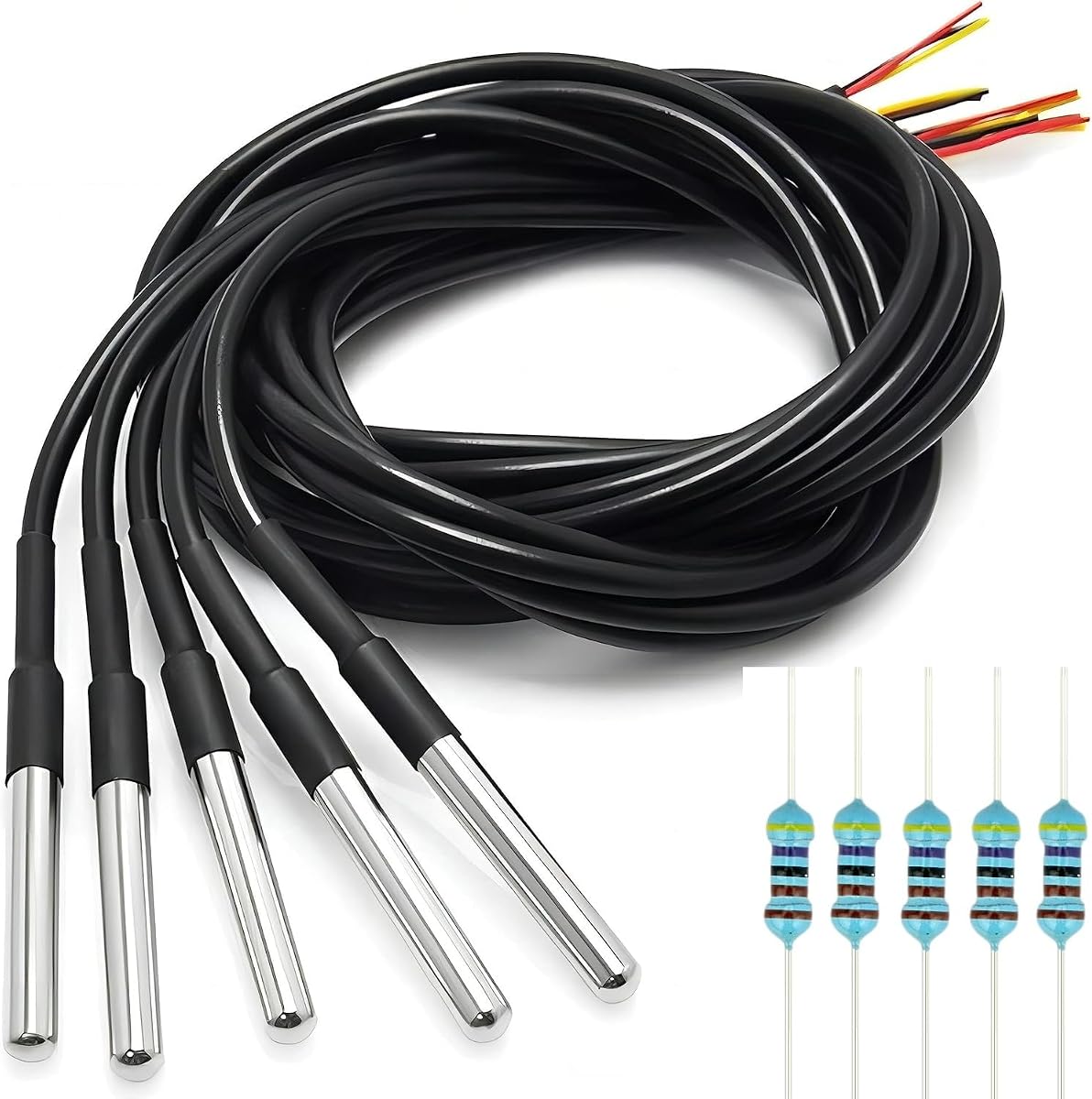
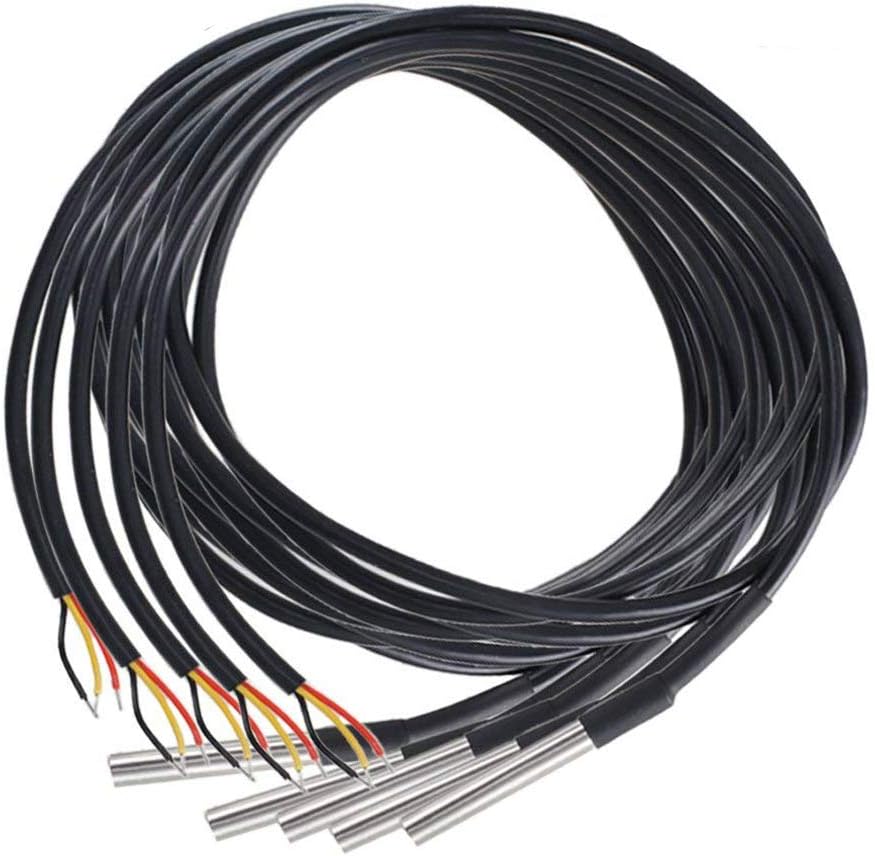
This pack includes five DS18B20 Temperature Sensor Cable with Probe units offering great value for multi-sensor setups. It features a stainless steel package that is waterproof and designed for durability in moist environments.
We may earn a commission when you buy through this link, at no additional cost to you.
The wide temperature range of minus 55 to plus 125 degrees Celsius ensures it can handle diverse thermal conditions. Wiring uses red yellow and black leads for clear identification during installation.
Using a 4.7K resistor between the Data and VCC will make the testing of the probe easier. The waterproof design ensures it can be used in submerged or humid applications without damage.
This pack is ideal for users needing multiple sensors for distributed temperature monitoring. It offers reliable performance and long life due to the stainless steel construction and waterproof rating.
Pack of 5 units offers great value for multi-sensor setups and distributed monitoring projects.
Stainless steel package ensures the probe is waterproof and resistant to moisture and corrosion.
We may earn a commission when you buy through this link, at no additional cost to you.
Selecting the right temperature sensor depends on your project requirements accuracy needs and environmental conditions.
There are two main types of temperature sensors: analog and digital. Digital sensors like the DHT11 or DS18B20 offer easier integration because they provide calibrated digital output that can be read directly by microcontrollers without external analog-to-digital converters. Analog sensors require more circuitry and calibration but can be useful for custom applications where specific ranges are needed.
Choose digital sensors for simplicity and reliable output in most Arduino projects.
Accuracy refers to how close the sensor reading is to the true temperature while resolution is the smallest change in temperature the sensor can detect. For general monitoring applications sensors like the DHT11 offer acceptable accuracy but for scientific or industrial projects you may need sensors like the SHT31 which offer higher precision and lower error margins.
Higher accuracy and resolution improve reliability but often come with higher cost and complexity.
Check the operational temperature range to ensure it covers your application requirements. Some sensors only work between 0 and 50 degrees Celsius while others support ranges from minus 55 to 125 degrees Celsius. Choosing a sensor outside its range may lead to damage or inaccurate readings.
Match the sensor range to your environment to avoid errors or hardware failure.
Sensors communicate via different protocols such as single-wire, I2C, or UART. Single-wire sensors like the DS18B20 are easy to wire and support multiple units on a bus. I2C sensors allow simultaneous communication with multiple devices using two data lines which is useful for compact designs.
Select an interface that matches your microcontroller's available pins and communication needs.
For outdoor or liquid immersion projects, waterproof sensors are essential. Waterproof sensors feature sealed probes made from stainless steel or plastic that can withstand moisture and corrosion. Non-waterproof sensors are suitable only for indoor or dry environments.
Use waterproof sensors when exposure to moisture or submersion is expected.
Voltage requirements vary between 3.3V and 5V depending on the sensor. Most Arduino boards operate at 5V so choose sensors compatible with this voltage to avoid additional regulators. Low power consumption is also important for battery-powered applications.
Ensure voltage compatibility and power efficiency match your project's power supply.
Budget constraints may dictate your choice between basic and premium sensors. While high-accuracy sensors cost more they provide better reliability for critical applications. Check availability to ensure consistent supply for ongoing projects.
Balance performance needs with budget and supply chain availability.
Most sensors have well-supported Arduino libraries that simplify code development. Check if the sensor has an active community and library support to speed up your project timeline. Lack of library support may require writing custom drivers which adds complexity.
Prioritize sensors with strong community support and ready-to-use libraries.
Connect the sensor to your Arduino using the specified voltage and ground pins. Ensure you use pull-up resistors if required by the sensor protocol to maintain stable signal levels.
Upload a compatible library sketch to read data and calibrate if needed. Verify the readings using a reference thermometer to ensure accuracy before deploying.
Protect the sensor from extreme environments beyond its ratings to ensure longevity. Regularly check connections and wiring to maintain reliable performance over time.
For high accuracy, sensors like the SHT31 or AHT30 offer precision up to plus or minus 0.3 degrees Celsius. These use I2C communication which reduces noise and improves reading stability compared to single-wire sensors.
Yes, waterproof models like the DS18B20 with stainless steel probes are designed for underwater or moist environments. Always verify the waterproof rating and avoid using non-waterproof sensors in such conditions.
Most sensors operate between 3.3V and 5V. Always check the datasheet to ensure compatibility with your Arduino board's output voltage to avoid damage.
The DHT11 is one of the easiest due to its simple single-wire interface and broad library support. It requires minimal circuitry and is ideal for beginners.
With single-wire sensors like DS18B20 you can connect many on one bus using unique addresses. I2C sensors allow multiple devices but require distinct addresses and more wiring.
Some sensors like DS18B20 require pull-up resistors for stable data. Many modules include these resistors onboard to simplify wiring.
For indoor monitoring the DHT22 or DHT11 provide good temperature and humidity data at low cost. They are widely supported and easy to integrate.
Calibration with a known reference and shielding from direct heat sources can improve accuracy. Also ensure stable voltage supply and avoid electrical noise on data lines.
We reviewed ten top Arduino temperature sensors ranging from basic modules to high-precision options. Each offers unique strengths tailored to different project needs and environmental conditions.
Prioritize accuracy and waterproofing if your project requires reliability in harsh environments. For hobby projects simple and affordable sensors provide sufficient performance.
Check current stock and availability before ordering to ensure you can proceed with your project without delays.